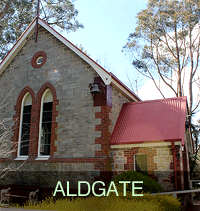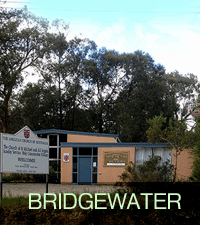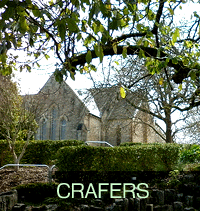
Our Anglican Parish of Stirling is located in the beautiful Adelaide Hills in South Australia, and encompasses Crafers, Stirling, Aldgate, Bridgewater and surrounding areas. The Stirling Parish has three different centres offering varying styles of worship and activities.
We try to live out what is traditionally called the kingdom of God, which is life as God intends it to be. The kingdom of God is life in which we care for the earth, treat others as we would like to be treated, work for peace and cooperation and trust in a positive future. Who doesn’t want that?
What is special about that ‘kingdom’ is there is no single ruler. Everyone is sovereign. That’s the freedom of following Jesus’ way. It means every person is free to live out their humanity as they think best. For that reason, for the church, or any other organisation, to tell people how they should live, contradicts God’s kingdom. That doesn’t mean how we live doesn’t matter, for despite appearances, the less loving we are, the less alive we are, for we are out of sync with creation.
Of course, Jesus’ way is love, but we all have our own way of expressing that. For that reason, our parish doesn’t have a list of statements of what we believe, or what you have to assent to, in order to belong. For most people, it’s a work in progress. God doesn’t want us to be all the same, but to be as one.
Part of the joy and challenge of belonging to a church is getting along with each other. It is imperative, because we need each other! Another way of saying that, is, there’s no salvation (i.e. life with God) apart from others. Kindness and forgiveness towards others and ourselves are essential, because they allow us to learn from mistakes.
In the Bible, the word translated as belief or faith, doesn’t mean holding on to ideas that cannot be proven. Instead, it refers to holding information that’s true and useful, and living it out in your life. Belief in Christ then, means doing that in the context of Christ. The context of Christ is seen in Jesus’ life: relaxing into God, through trusting the way the universe runs and living in sync with it, in a way that comes to fruition in love.
The Bible tells us that in Christ, there is no status tied to any other sort of belonging. For that reason, your culture, race, sexuality, gender and hair colour, have no relevance to your worth, or eligibility to belong to the church. Its only relevance is how you are yourself and what you bring to the community of humanity.
We worship God, who is not a thing or a being, but that which makes anything able to come into being. Conceived of as a trinity, which is a nifty way of saying God is love, we see creation reflecting the nature of God, as a unity of interdependent relationships. That pattern of life, is manifest explicitly in Jesus, who shows us that not only is living in love, being fully human, it is also being one with God. Jesus’ resurrection reveals the power of love transcends everything, so we need not fear what we think threatens us.
Not everyone in our parish comes to church for the same reason. Some doubt they’re close to God or understand what it’s ‘really’ about, but I think we connect with God in different ways, even without knowing. The church has no monopoly on God, but it does aim to be a community of people encouraging each other to live deeply through giving themselves away. We can do that alone by ourselves, to some extent, but it is really only possible if we let God ‘recreate’ us, so it’s not something we try hard to do, but want to and enjoy doing. Generally speaking, that requires going through a process we can’t orchestrate ourselves, and if we do control it, then it will likely be less than the transformation/recreation required.
In order to truly love others, we have to know we are loved. In other words, we have an intrinsic worth that cannot be taken away and nothing can truly deny that. To know that in the depths of our being, we usually have to be ‘deconstructed’, which means cease getting our sense of worth from the ways the world sells it to us. Breaking bread together in the Eucharist encapsulates that process and encourages us to let it happen. That’s the power of a community committed to love.
Rev’d Andy Wurm
Parish Priest